
A return window that works fine for a hammer won’t work the same way for a refrigerator or a gallon of paint. Home improvement retailers know this, which is why their policies aren’t one flat rule.
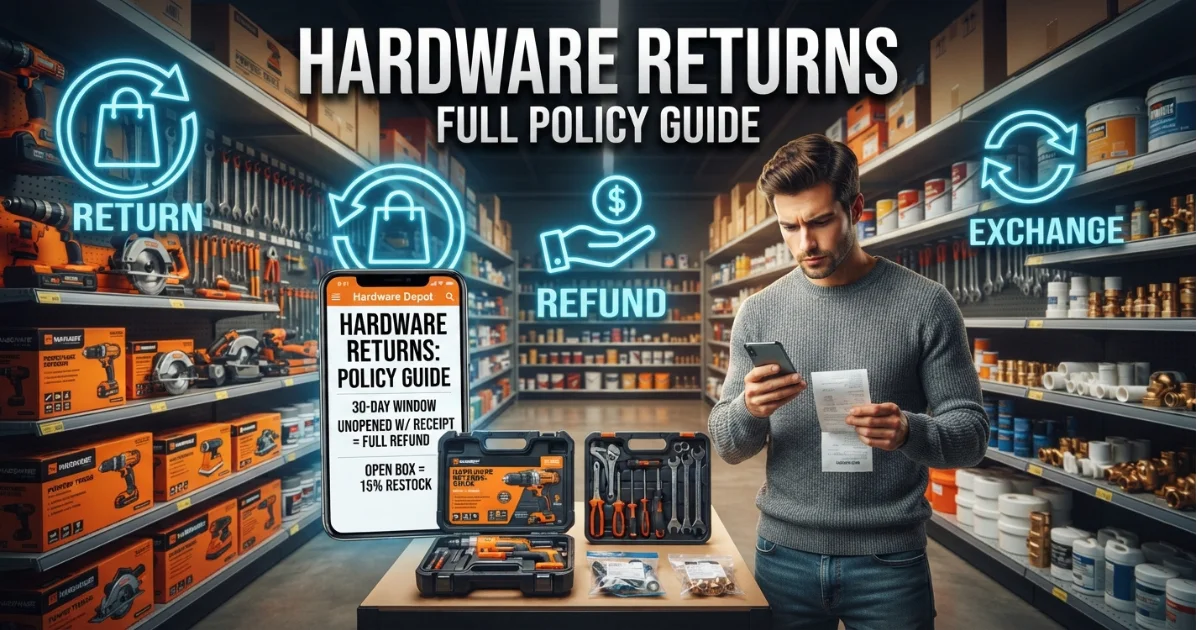
This guide covers hardware and home improvement returns across major retailers — the standard rules, the exceptions that catch people off guard, and how a home decor store like At Home compares.
What Is a Standard Return Policy for Home Improvement Products?
Before diving into exceptions, it helps to know what “normal” actually looks like at most home improvement retailers.
What is a standard return policy for products? What is a standard return policy? Most major hardware retailers give you a 90-day window for new, unused merchandise, provided you have proof of purchase. This is the baseline most stores build their exceptions around.
Proof of purchase doesn’t always mean a paper receipt. Many retailers can look up your order using the card you paid with, your phone number, or a linked loyalty account. This matters more than people realize, since a lost receipt used to mean a lost refund.
Refunds typically go back to your original payment method when you have valid proof of purchase. Without it, you’ll usually get store credit instead, based on the item’s current selling price rather than what you originally paid.
Why Some Items Have Shorter Return Windows

The 90-day standard sounds generous, until you realize several high-ticket categories don’t get anywhere close to that long.
Major appliances — refrigerators, washers, dryers, ranges, dishwashers — often get as little as 48 hours from delivery or pickup. That window can stretch to 30 days if you paid with a store credit card and the appliance stays sealed and unopened. The short timeline exists because appliance defects usually surface fast, and retailers need to catch damage before resale becomes impossible.
Liquid paint typically gets a 30-day window and must be returned in like-new condition with the original receipt. Once mixed to a custom color, paint essentially can’t be resold, which is why this category gets tighter rules than dry goods.
Electronics and outdoor power equipment follow a similar shorter-window pattern, generally landing around 30 days instead of the full 90. High resale risk and rapid depreciation are the main drivers here — a returned generator or power tool loses value fast once it’s been used even briefly.
What Is At Home’s Return Policy?
At Home operates more like a home decor retailer than a traditional hardware store, and its return rules reflect that difference.
What is At Home’s return policy? Unused items in original packaging can be fully refunded within 60 days of purchase, extending to 90 days for Insider Perks loyalty members, as long as you have proof of purchase and a valid ID.
A few categories are excluded entirely. At Home does not accept returns on mattresses or box springs, and pillows or cushions must still have all original tags attached. Items marked “All Sales Final” follow that label exactly — no exceptions.
One detail worth noting: At Home doesn’t offer traditional exchanges. Instead, you return the unwanted item and separately purchase the replacement, which is a slightly different process than swapping directly at the counter.
What Is the Return and Refund Policy? (Home Improvement Norms)
“Return policy” and “refund policy” get used interchangeably, but in home improvement retail, they lead to genuinely different outcomes.
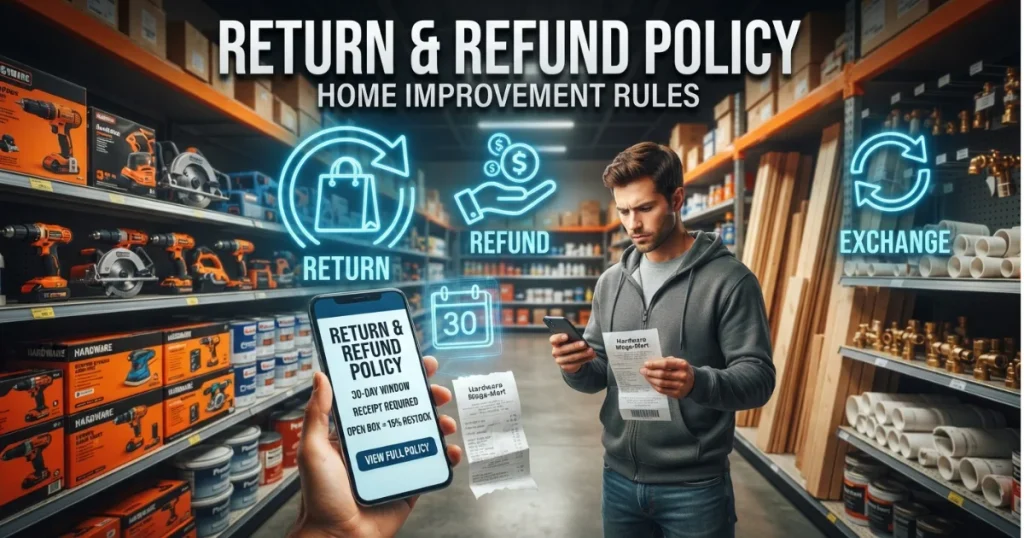
What is the return and refund policy? A return determines whether an item can come back to the store at all. A refund determines what you get in exchange — cash back to your card, or store credit. Having a receipt is usually what decides which outcome you get.
Returns without a receipt aren’t automatically denied. Most retailers will ask for a valid photo ID and issue store credit at the manager’s discretion, based on the item’s current price rather than what you paid.
Custom and special orders — think cut-to-size blinds, tinted paint, or made-to-order cabinetry — sit in their own category. These are frequently final sale, or carry a restocking fee, often around 20 percent, since the retailer can’t simply put a customized item back on the shelf.
Understanding Different Return Policy Types
Once you see the pattern, most return policies fall into one of just a few structures — which makes shopping a lot less confusing.
What is a 7 days return policy? This shorter model is common with smaller retailers and items closer to perishable — think plants, cut flowers, or fresh-cut materials. If seven days pass, the return window closes completely, with no extensions.
What are these three return policies? Broadly, home improvement and home goods retailers tend to use three structures: the standard model (30 to 90 days, the most common), the extended or loyalty-tiered model (60 to 365 days depending on membership or credit card use), and the short-window model (around 7 days, used for perishable or fast-depreciating items).
Knowing which type applies before you buy is simple: check whether the item is a major appliance, paint, electronics, or a custom order. If it’s none of those, the standard 90-day window almost certainly applies.
FAQs About Hardware & Home Improvement Returns
What is the standard return policy for products?
Most home improvement retailers offer a 90-day return window for new, unused items with proof of purchase, with refunds going to the original payment method.
What is At Home’s return policy?
At Home offers a 60-day return window, extended to 90 days for Insider Perks members, for unused items in original packaging with proof of purchase.
What is the return and refund policy?
The return policy determines whether an item is eligible to come back. The refund policy determines the outcome — cash back with a receipt, or store credit without one.
What is a standard return policy?
A standard return policy generally allows returns of new, unused merchandise within 30 to 90 days of purchase, with proof of purchase required for a full refund.
What is a 7 days return policy?
A 7-day return policy is a shorter window common with smaller retailers or fast-depreciating and perishable-adjacent items, with no extensions once the week passes.
What are these three return policies?
The three common structures are the standard model (30-90 days), the extended or loyalty-tiered model (60-365 days), and the short-window model (around 7 days).
Conclusion
Hardware and home improvement returns come down to category and payment method more than the store itself. Major appliances, paint, and custom orders play by shorter, stricter rules, while everything else usually falls under a generous standard window. Check the item type before you buy, and keep your receipt — it’s still the fastest path to a full refund.